
WHO Database Shows Shale Gas Continues to Significantly Improve U.S. Air Quality
Tuesday July 5, 2016
New World Health Organization (WHO) urban ambient air pollution data shows U.S. outdoor air quality has improved in recent years at the same time the rest of the world’s outdoor air pollution has increased 8 percent. Even more notably, WHO data confirms fine particulate matter (PM 2.5) pollution continues to fall in the U.S., which — as EID has highlighted before — is a direct function of the shale gas revolution.
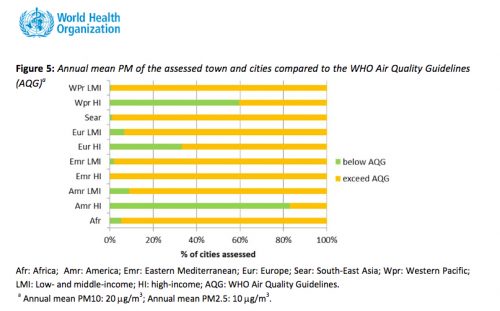
WHO’s comprehensive database, covering 3,000 cities in 103 countries, shows more than 80 percent of people living in urban areas that monitor air pollution worldwide are exposed to PM 2.5 concentration levels that exceed WHO standards. In sharp contrast, the WHO data show just 20 percent of people living in urban areas in the U.S. are exposed to PM 2.5 levels that exceed WHO standards, which are far more stringent than the U.S. Environmental Protection Agency’s.
As the following WHO graphic shows, a far larger percentage of cities in the “Amr HI (America high income)” category — which includes the U.S. and five other countries — reported PM pollution well below WHO air quality guidelines in 2013.
For perspective on the significance the latter, consider that EPA says PM 2.5 can cause “early death, cardiovascular or respiratory harm,” while WHO’s is even more blunt in its assessment, stating
“… Ambient air pollution, made of...